With the constantly changing digital marketing environment, lead generation is the main pillar of business expansion. In simple terms, lead generation can be defined as the process of identifying and transforming strangers into people interested in your product or service into potential customers. However, the competitive environment in 2026 requires you to be on top of the competition, with manual tracking down of your leads no longer an option since you must have the correct tools to be on top.
Lead generation tools have changed the way businesses recognize, identify, capture, and nurture prospects. These advanced tools roboticize repetitive processes, can give useful customer behavior insights, and allow effective personalized communication on a large scale. If you are starting a business, marketing for another company, expanding, or supporting an agency with several clients, the appropriate lead generation tools can significantly increase your conversion rates and ROI.
This ultimate list discusses the 12 lead generation tools that are most effective in making businesses prosper in 2026. Whether it is all-in-one CRM platforms or specialty prospecting tools, we will look at each solution with its respective strong points, its best usage scenario, and its prices so that you can make informed decisions for your business.
Lead Generation Tools: What Are These?
Lead generation tools refer to computer-based software applications that assist companies in identifying, attracting, getting, and developing potential clients in an orderly manner, during their purchasing process. These tools automate the previously manual and time-intensive process into automated and data-driven flows.
Lead generation tools are divided into two main groups: inbound and outbound. Inbound tools concentrate on the appeal of prospects by way of valuable material, landing pages that are optimized by search engines, interactions and engagements in social media, and experience on the web that is conversion-optimized. These tools will assist you in drawing interested buyers to your brand in a natural manner.
Outbound tools, in turn, facilitate active outreach by means of email campaigns, social selling websites, prospecting databases, and cold outreach automation. Most successful businesses normally adopt both methods in order to leverage their lead generation opportunities to the maximum.
Characteristics to Consider When Selecting Lead Generation Tools
When selecting the lead generation tools, it is highly important to consider features that relate directly to your capacity to attract and convert prospects.
Lead Capture Forms & Pop-ups need to be very customizable to your brand, mobile responsive to ensure smooth experiences across all devices, and triggered intelligently depending on your visitor behavior, e.g., exit intent, scroll depth, time on page, or even page visit. The most optimal tools have many forms, such as lightbox pop-ups, slide-ins, embedded forms, floating bars, and full-page takeovers.
Automation and Workflows allow you to develop advanced nurture series that steer leads in your sales funnel without human intervention. Find tools that will enable you to initiate behaviors according to particular behaviors, dynamically segment contacts as they interact, score leads automatically, and provide personalized content at the most opportune time in the buyer experience.
It is essential to have CRM Integration to ensure that you have one source of truth regarding your leads and customers. The coordination with the current CRM, email service, calendar application, and other marketing applications will be seamless, so that lead data will automatically be transferred between systems, avoiding the necessity of manual data entry, minimizing errors, and lost opportunities.
Analytics and Reporting bring the knowledge that can be used to keep optimizing your lead generation. Critical metrics are conversion rates by traffic source, cost per lead, score of lead quality, ROI of a campaign, visualisation of the funnel, revealing drop-off points, and attribution modelling to determine what touchpoints convert. The sophisticated platforms provide real-time dashboards, personalized reports, and predictive analytics.
Predictive Scoring and AI apply the same machine-learning principles that analyze historical data to find patterns of purchase intent. The technology is used to assist the sales team to focus on opportunities that have high value, outreach in ways that are tailored to preferences predicted, and predict conversion probability, which radically increases efficiency and close rates.
Compliance Features help to make sure that your lead generation practices are in line with data privacy laws such as GDPR in Europe, CCPA in California, and others. Critical compliance will be incorporated, such as consent management of opt-ins, data retention management, the right to be forgotten, data access audit capabilities, and secure data storage with encryption.
Also Explore: Best Software Companies in Coimbatore
Best 12 Lead Generation Tools of 2026
1. HubSpot Marketing Hub
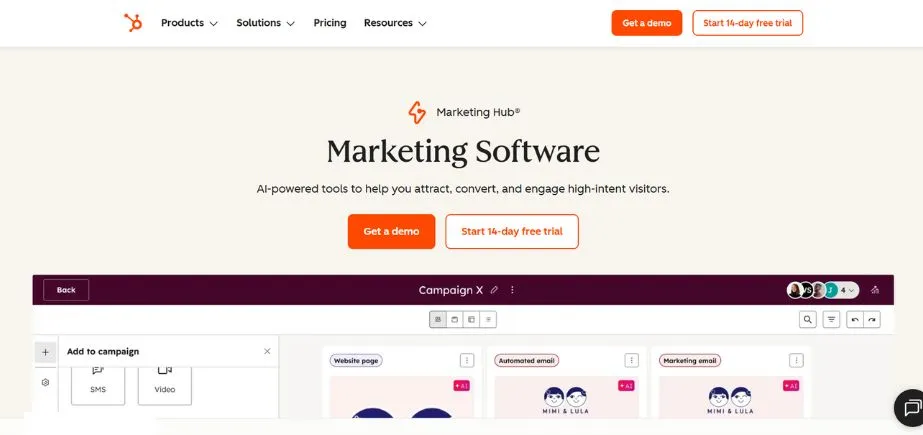
HubSpot Marketing Hub is one of the lead generation tools with an integrated combination of CRM capabilities, email marketing, landing page development, and sophisticated analytics in a single ecosystem. Having user experience at its fundamental center, HubSpot enables firms of any size to make complex inbound marketing strategies work without the need for deep technical knowledge.
The real power of the platform is that it allows removing data silos with the help of linking marketing and sales teams with a common database, where all customer interactions are recorded and used. Providing a holistic set of tools to modern-day marketers, HubSpot handles lead capturing with optimized forms up to a point of nurturing the leads with customized email workflows.
Key Features:
- Email, landing page, and form drag-and-drop editors.
- Behavioral-triggered workflow automation.
- Combined free customer relationship management and contact management.
- Lead scoring- engagement metrics.
- 1,000 or more native integrations and an app marketplace.
Pros:
- Extraordinary non-technical team ease of use.
- Intensive free tier and true value.
Cons:
- Premium price increases with the growth of contact.
- A high level of customization demands technical expertise.
Best Uses:
Expanding companies, inbound marketing, alignment of sales-marketing, start-ups, and businesses.
Pricing:
Free; Starter costs $45 / month, Professional costs $800 / month, Enterprise costs $3,600 / month.
2. Salesforce Marketing Cloud
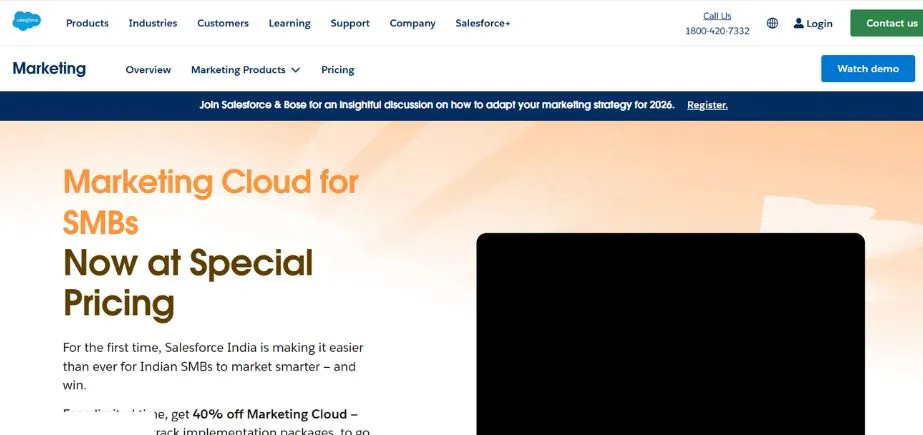
Salesforce Marketing Cloud is the highest point of marketing automation designed to serve large companies that operate interwoven customer experiences through a variety of channels. The lead generation tools like these use Einstein AI to provide predictive analytics, customized suggestions, and smart automation that dynamically responds to customer behavior.
Marketers will have the ability to build complex campaigns that smoothly cross email, mobile, social media, advertising, and web experiences with Journey Builder at its core to create unified brand interactions no matter the touchpoint. The Account Engagement (previously Pardot) product of the platform focuses on B2B marketing automation, providing lead nurturing, scoring, and attribution modeling.
Key Features:
- Journey Builder to cross-channel campaigning.
- Einstein’s foresight analytics and individualization AI.
- B2B automation, Account Engagement (Pardot).
- Integrated audience division instruments.
- Inbuilt Salesforce CRM system.
Pros:
- Scalability that is unparalleled for enterprises.
- High-tech AI-driven insights and advice.
Cons:
Huge training is needed to operate it.
High implementation and licensing costs.
Best uses:
Enterprise businesses, multifaceted sales cycles, sophisticated personalisation requirements, Salesforce users.
Pricing:
Custom pricing; more often than not, $15,000-50,000+/year based on features and size.
3. Pipedrive
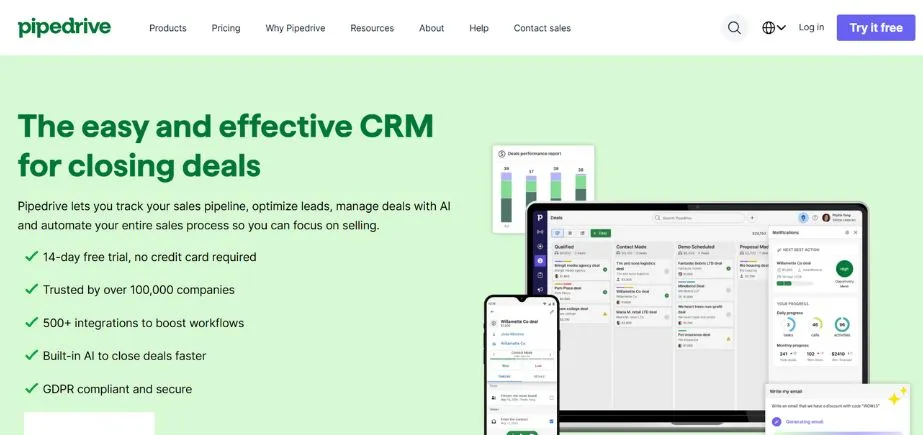
Pipedrive is an innovative way to manage a sales pipeline that optimizes the process of tracking a complex deal into an intuitive visual interface that sales teams can actually enjoy using. Created by salespeople to be used by salespeople, it is highly focused on simplicity and actionability without feature bloat and, therefore, achieves high adoption rates even in traditionally CRM-averse teams.
The platform has a distinctive visual pipeline that has a drag-and-drop interface, which allows deals to flow through customizable pipeline stages to provide immediate insight into the health of the pipeline and its bottlenecks. The essence of Pipedrive’s selling activities is in its philosophy, such that no follow-up should be lost in the drain. Its AI-powered sales assistant uses historical data to predict the result of the deals, recommends the next best action, and detects at-risk opportunities.
Key Features:
- Drag and drop visual sales pipeline.
- Artificial intelligence sales assistant and forecasting.
- Automated reminder activity-based selling.
- Integration and functionality of email and tracking features.
- iOS and Android mobile applications.
Pros:
- Extraordinary user friendliness guarantees team adoption.
- Small and mid-size teams can afford it.
Cons:
- Poor marketing automation capabilities.
- Comparison between basic reporting and enterprise platforms.
Best uses:
Smaller to medium-sized sales teams, graphs of effects, selling activities, and less expensive CRM requirements.
Pricing:
Essential, $14/user/month, Advanced, $29/user/month, Professional, $49/user/month.
4. ActiveCampaign
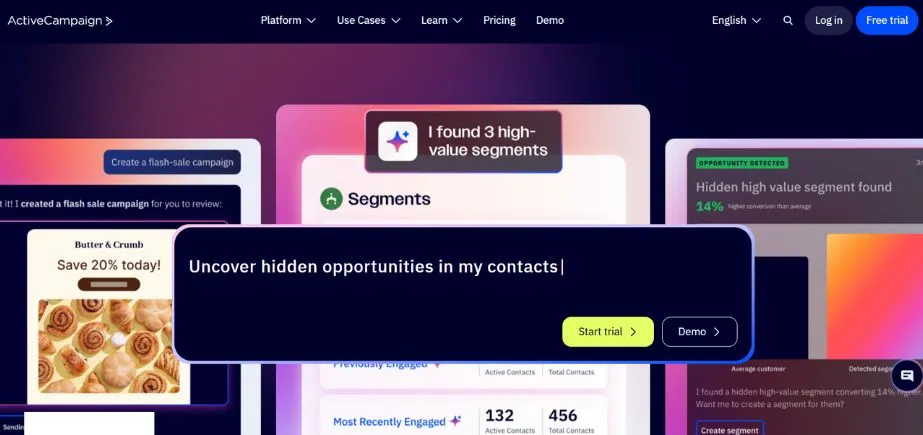
ActiveCampaign is one of the genius lead generation tools the way it balances the needs and desires of email marketing platforms and CRMs that are full-fledged, offering mid-market pricing of enterprise-level marketing automation that has democratized complex customer interaction. Platform The platform is an industry leader in building complex email automation with conditional logic that enables marketers to build individualized customer journeys that dynamically react to subscriber behavior, preferences, and engagement patterns.
Its built-in CRM module tracks deals in customizable pipelines and has full visibility about all marketing touchpoints, making sales teams know a lot about prospects before reaching out to them. Predictive sending applies machine learning to assess the best time to deliver a message to an individual that will maximize the rate of opening and engagement.
Key Features:
- Highly automated email forms with conditional logic.
- Pipeline management: integrated CRM.
- Optimization of predictive sending.
- Personalization of dynamic content.
- SMS marketing integration
Pros:
- Best automation at affordable costs.
- Good rates of email deliverability.
Cons:
- Novices are lost in complexity.
- Basic Web landing page capability.
Best for:
E-commerce companies, B2B cultivation campaigns, e-mail-driven conversions, and advanced automation requirements.
Pricing: Lite 29/month, Plus 49/month, Professional 149/month, and Enterprise custom.
5. OptinMonster
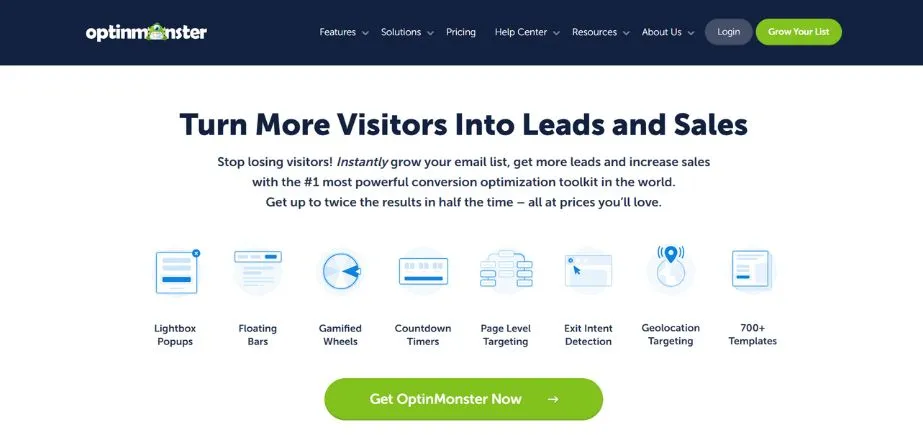
The single focus of OptiMonster is the critical conversion stage, i.e., the transformation of anonymous visitors of the site into named leads with the help of specially designed pop-ups, slide-ins, and eye-catching designs. This narrowed-down solution enables OptinMonster to be the recommended solution to businesses that have a challenge of high traffic yet poor conversion rates. The library of templates is very large, and it offers conversion-optimized templates that can be adjusted to suit any brand aesthetic.
More sophisticated targeting technologies make sure that the correct message is delivered to the correct visitor at the correct time based on dozens of factors such as geographic location, the source of traffic, the type of device, how much the visitor scrolls, their exit intention, and even previous behavior.
Key Features:
- Large template library optimization.
- Behaviour-based and attribute-based advanced targeting.
- Exit-intent technology to track abandoned visitors.
- Constant optimization: A/B testing.
- Integration of the email platform and CRM.
Pros:
- Simple drag and drop editor without the need to write code.
- Very useful in bouncing reduction.
Cons:
- Concentrates on capture and not nurturing.
- Frustrates visitors when it is ill-conceived.
Best for:
Content publishers, e-commerce websites, high-traffic and low-conversion websites, and fast list growth.
Pricing:
Basic: $9/month, Plus: $19/month, Pro: $29/month, Growth: $49/month
6. Unbounce
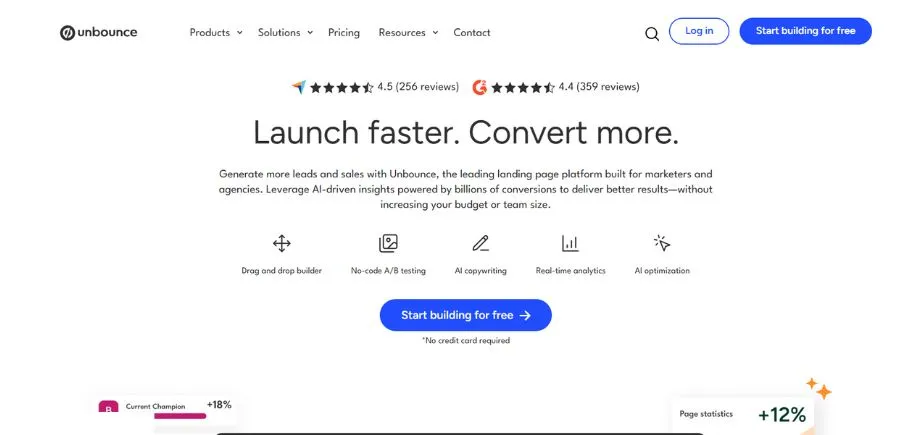
Unbounce is the same platform that allows the marketer to create, publish, and optimize high-converting landing pages without relying on developers or IT resources, which makes it the preferred platform when the business invests heavily in paid advertising campaigns. The drag-and-drop builder of the platform offers a significant level of customization and still allows adding custom code when necessary, allowing just the right balance between usability and creativity.
Unbounce has an AI-optimization feature, Smart Traffic, that automatically directs visitors to the landing page variant that is most likely to convert, based on their attributes and behavior, and is essentially a continuous optimization process that is operated automatically.
Key Features:
- Drag-and-drop Web page creator.
- Smart Traffic optimization by AI power.
- B/A testing of each element of the page.
- Personalization of dynamic text replacement.
- Additional capture pop-ups and sticky bars.
Pros:
- Intentionally designed to convert the most.
- Optimization of AI enhances the outcomes automatically.
Cons:
- Premium price compared to low-end builders.
- Concentrated on landing pages, not websites.
Best for:
Marketing agencies, paid advertising campaigns, conversion optimization focus, A/B testing.
Pricing:
Launch- $99/month, Optimize- $145/month, Accelerate- $240/month, custom Concierge.
Know More: Best Finance Companies in Bangalore
7. LinkedIn Sales Navigator
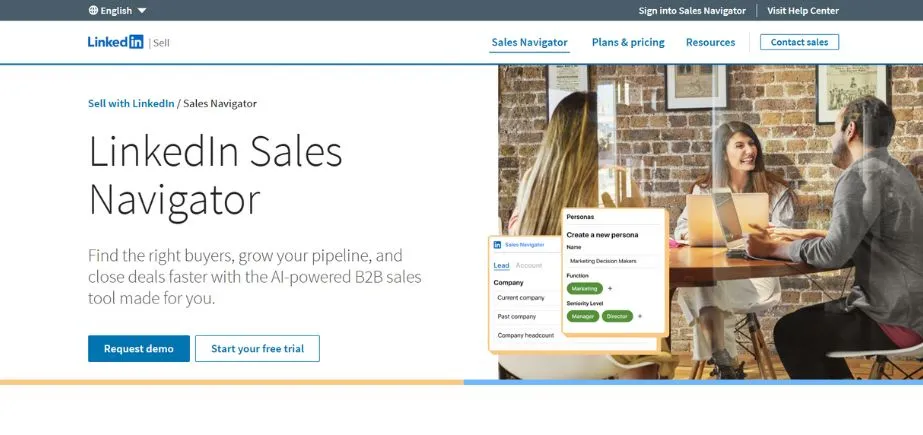
LinkedIn Sales Navigator converts the largest professional network in the world into an exact-match B2B prospecting engine that offers sales professionals an unmatched access to decision-makers and buying committees. Having more than 900 million members on LinkedIn, Sales Navigator has a powerful search system that narrows down the prospects based on 40 or more criteria, such as job title, company size, industry, geography, level of seniority, and even growth rates of the company.
The lead recommendations in the platform are AI-based, and it will always recommend to you prospects that match exactly your desired customer profile, and this will streamline your pipeline with qualified prospects, which you may never have found otherwise. Sales alerts keep you informed about the new jobs, content status, and appearances of any prospects in the news, and give you the best topics to discuss with them at the right time and place.
Key Features:
- Dynamic search with 40+ filter options.
- The lead recommendation is based on AI.
- Real-time notifications in prospect activities.
- Direct outreach message through InMail.
- Group connections through TeamLink.
Pros:
- The unmatched access to B2B decision-makers.
- Familiar greetings have a high response rate.
Cons:
- Individuals and small teams receive premium pricing.
- Even paid plans have a limit on the usage of InMail credits.
Best for:
Sales teams- B2B, enterprise targeting, professional services, account-based marketing, social selling.
Pricing:
Core, Advanced, and Enterprise custom pricing: $99/month/user, $149/month/user, and Enterprise.
8. Hunter
The unproductive process of searching professional email addresses is removed by Hunter, so the time spent on outbound prospecting is reduced, and sales teams can concentrate on nurturing relationships instead of researching. The email finder feature on the platform only needs someone to enter their name and business domain before finding their professional email address with a staggering level of accuracy, and all this is based on a database that is created due to one of the company’s constant web crawlers and pattern recognition.
Domain search helps to uncover all available email addresses that are related to a certain company and provides a comprehensive account-based outreach approach. The application and email verifier ensure validity prior to sending to safeguard your sender image and undesirable bounce rates that harm deliverability.
Key Features:
- Name and company domain email finder
- Domain search to find contacts in the company in all domains.
- Email checker protection deliverability.
- Workflow integration Chrome extension.
- Scale prospecting by bulk processing.
Pros:
- Good precision in addresses found.
- Automation provides time savings by doing away with manual research.
Cons:
- Only email address is allowed (no phone numbers)
- It is accurate based on information that is publicly available.
Best for:
Sales development teams, outbound campaigns, recruiter sourcing, journalist research, B2B prospecting.
Pricing:
Free (25 searches), Starter $49/month, Growth $99/month, Business $399/month.
9. Intercom
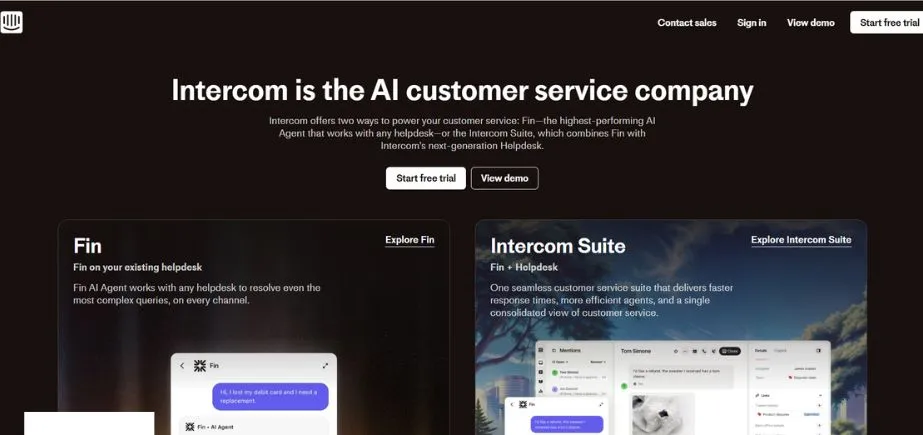
Intercom is one of the earliest lead generation tools to practice the idea of conversational marketing and support, speaking with the website visitors via live chat, smart chatbots, and targeted messaging that converts at the point of the greatest intent. The site has understood that consumers of this age and generation like to talk instead of filling out the forms, and so they offer immediate solutions to queries that could otherwise lead to abandonment.
Relevant questions, the collection of contact information, and the transfer of qualified candidates to relevant salespeople with the help of the chatbot qualify leads automatically, which is important since it saves time and resources otherwise spent on human evaluation. Personalized campaigns are offered through targeted messages, personalized based on the behavior of the visitor, the attributes, and the stage of the lifecycle, making your site an active and responsive marketing channel. SaaS products have product tours that transport users through their features and activation of drives.
Key Features:
- Team collaboration live chat with team features.
- Privatized chatbots to qualify automatically.
- Attribution and behavior-based targeted messages.
- Onboarding user tours.
- Full history of conversation in the inbox.
Pros:
- Much more of conversion with immediate action.
- Automatic qualification liberates sales teams to make a sale.
Cons:
- Small businesses can find premium pricing expensive.
- Needs employees to be available to deal with live chats.
Best For:
SaaS businesses, e-commerce cart abandonment, appointment booking, high-inquiry businesses, and real-time engagement.
Pricing:
Begins at $74/month; increases with contacts and features to hundreds/thousands monthly.
10. Drift
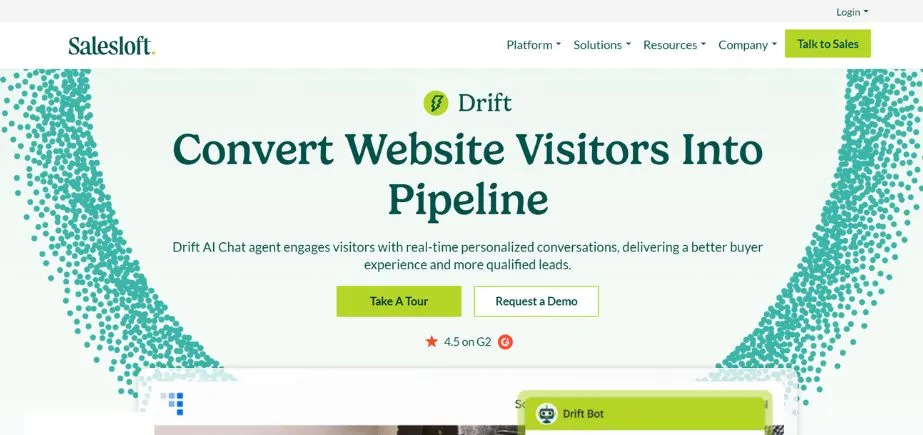
Drift is changing the process of generating business leads. Instead of using a stagnant contact form, it provides an interactive dialogue to qualify buyers and book a meeting in real-time, shortening sales cycles and increasing conversion rates at the same time. The conversational marketing strategy of the platform acknowledges that B2B buyers do comprehensive research prior to buying, and when they are willing to communicate, they desire to have instant access to knowledgeable representatives.
The intelligent chatbots of Drift greet visitors immediately and ask qualifying questions to establish fit, budget, authority, and need, as well as gather contact information of visitors by holding conversational interactions. The in-built scheduler of meetings inspects the calendars of the sales representatives and makes appointments without the email back-and-forth interaction that slows down the engagement and chances of losing prospective buyers.
Key Features:
- Chatbots: Conversational chatbots are used to engage in real-time communication.
- Combined meeting planner and calendar integration.
- Targeting capabilities: Account-based marketing targeting
- Video messaging as a personal outreach strategy.
- Tracking of revenue attribution.
Pros:
- Drastically shortens the sales cycles.
- Excellence in buyer experience over forms.
Cons:
- Premium pricing is aimed at the middle and business levels.
- Needs avenues for the sales team to converse with.
Best for:
B2B businesses, high-value deals, short sales lifecycle, account-based marketing, conversational marketing.
Pricing:
Free tier; Premium is about 2,500/month, and Advance and Enterprise pricing are more expensive.
11. ZoomInfo
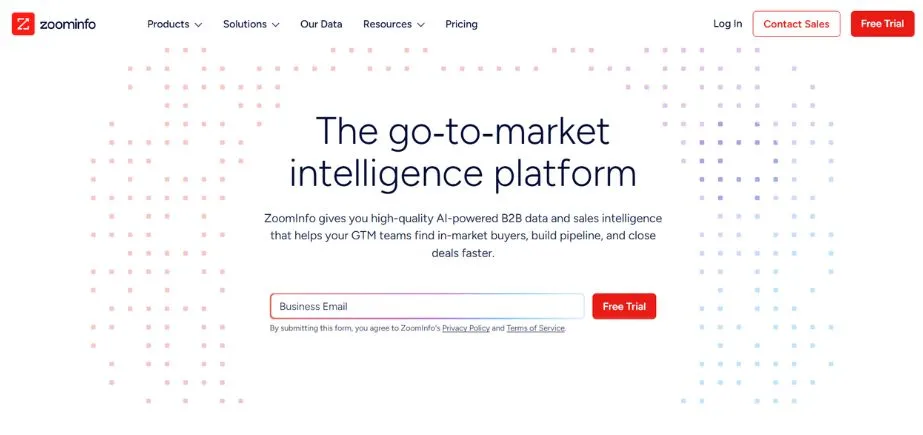
ZoomInformation is the largest B2B contacts database and sales intelligence platform in the market that provides the contact profile and 150 million professional contacts of more than 65 million companies, and the accuracy of the sales team is more reliable. The site transcends simple contact data and offers a ton of company intelligence, such as organizational charts, technology stacks, recent news, financing rounds, financial data, and competitive landscapes.
Buying intent data helps to focus on the companies that are currently investigating solutions in your category through tracking content consumption, web actions, and engagement patterns online, so that sales teams can approach the prospect at the optimal point in their purchasing process. CRM records are updated and filled in automatically through the automated data enrichment, and your sales team will always be working with the correct and up-to-date information.
Key Features:
- 65M+ company profiles, 150M+ professional contacts.
- Purchase intent information of active researchers.
- Automated CRM data enhancement.
- Multi-filtered advanced search.
- Company intelligence and organic organizational charts.
Pros:
- Best in class data breadth and depth.
- Intent data detects buying cycle prospects.
Cons:
- Enterprise pricing is costly in terms of budget.
- Contracts with restricted flexibility are annually renewed.
Best for:
Enterprise sales teams, account-based marketing, aggressive growth targets, market research, talent acquisition.
Pricing:
Custom pricing; this is usually in the range of 15,000+/year, may need to be in six figures in enterprise.
12. Cognism
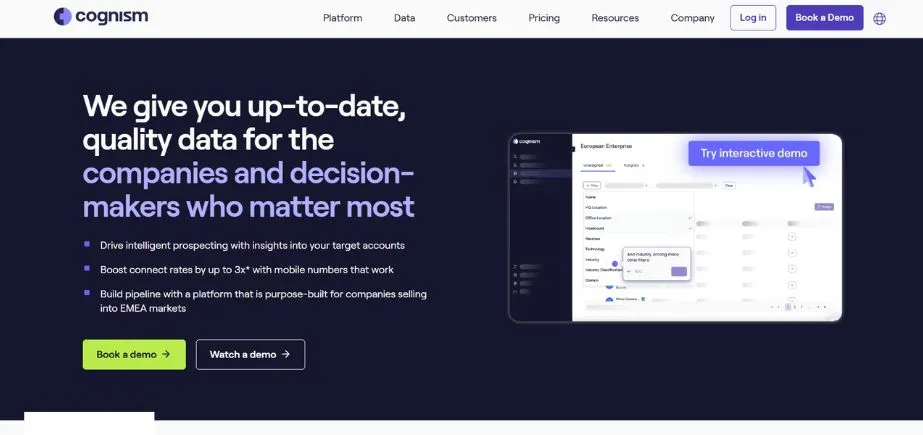
Cognism provides a fairly strong B2B sales intelligence powered by AI and implemented to work in international markets, in particular, in Europe, where the levels of data compliance and quality pose their own set of challenges. The Diamond Data attribute of the platform offers cell-verified mobile phone numbers with superior precision, which has a massive connection rate in contrast to the conventional databases used in businesses. It has a global coverage in North America, Europe, and Asia-Pacific, and there is always high-quality data in the areas that have been left behind by its competitors.
Technographic data can tell which technologies the companies are stacking, and they can see the opportunity to replace or complement their success. The compliance engine allows the organization to comply with GDPR, CCPA, and regional privacy laws, which is reassuring to organizations that have a significant presence in highly regulated markets.
Key Features:
- Mobile numbers have been verified as diamond data cells.
- International with a European focus.
- Buying signal intention data.
- GDPR/CCPA Adherence compliance engine.
- LinkedIn integration extension in Chrome.
Pros:
- Premier mobile number quality.
- Good market coverage and compliance in Europe.
Cons:
- Price is aimed at middle and corporate customers.
- The spread of data differs depending on the regions.
Best For:
- Targeting the European market, compliance-based organizations, confirmed mobile contacts, and account-oriented sales.
Pricing:
Custom pricing; average price is usually 10,000+ per year, depending on the part of the world and the needs.
How to Choose the Right Lead Generation Tools
The choice of the best lead generation tools can be done with lots of attention to a range of important factors in accordance with your business and business purpose.
Business Size and Budget are very important in determining the tools that are viable. The startup and solopreneur are encouraged to use free options and lower priced solutions such as the free CRM of HubSpot, the basic plan of OptinMonster, or the free level of Hunter. Mid-tier options such as ActiveCampaign, Pipedrive or Unbounce offer powerful features at affordable prices to small businesses with limited budgets. Business entities can invest in full-fledged systems such as Salesforce Marketing Cloud, ZoomInfo, or Cognism that can be scaled to meet sophisticated demands.
Target Audience will define the best channels and tactics to be used. B2B organizations that focus on business decision-makers must give preference to tools such as LinkedIn Sales Navigator, ZoomInfo, Drift, and Cognism that are superior in the field of professional networking and account-oriented tactics. B2C companies that communicate with consumers need to target social media tools, email marketing tools and web optimization tools such as OptinMonster that appeal to impulse attention.
Channels of marketing that will be used should be in line with your choice of tools. ActiveCampaign or HubSpot have solid email tools that are worth investing in in case email marketing is the place of most of your conversions. Landing page builders such as Unbounce should be of top priority should you use paid advertising as your main channel. In the case of social selling being the most important, LinkedIn Sales Navigator will be necessary. Multi-channel approach demands either point solutions having carefully integrated points, or all-in-one platform.
Connects to Existing Software, Data silos are avoided and provide seamless operations. Ensure any tool you are going to commit to is already native or built with platform support (Zapier) to your existing CRM, email platform, calendar, analytics tools, and other marketing technology. Failure to integrate brings about manual data entry, error and missed opportunities.
Scalability and Support: This means that your tools will expand with your business. You should think about whether the cost increases in a reasonable way as your contacts base expands, whether the platform can take on more complexity in your operations, whether the customer service is responsive and helpful, and whether the vendor continually upgrades and develops the platform.
Advantages of Lead Generation Tools
The proper application of the lead generation tools will provide a quantifiable business value in various aspects concerning your sales and marketing activities.
The improved Conversion Rates will be the product of fully optimized experiences, prompt usage, and customized communication. Landing pages can be optimized by tools such as Unbounce to raise landing page conversion rates by continuously testing the landing pages, and tools such as Drift can engage the prospect at the moment of interest maximization, and the likelihood of converting will be significantly increased.
Smart qualification and scoring result in better Lead Quality. Artificial intelligence software can make opportunities that fit your target customer profile, behavioral analytics can determine true interest and intent, and automated qualification can ensure sales teams follow opportunities with the highest likelihood of close instead of dead ends.
Effectiveness of your team is multiplied with time and Cost Efficiency. Repetitive manual processes such as data entry, research processes, and follow-up scheduling are done away with through automation. Applications, such as Hunter, will find email addresses within seconds and not hours of tedious research. Software such as ActiveCampaign will cultivate leads on its own, and your team can concentrate on more valuable tasks.
Improved Sales and Marketing Alignment destroys silos that afflict most organizations. Single sources of truth: Unified systems such as HubSpot and Salesforce have unified views that can be accessibly seen by both teams, a single view of the lead status and history, a handoff process to enable consistent handoff, and collaborative workflows, which leave no lead untouched.
Data-Driven Decision Making substitutes the guesswork with the evidence. Intensive analytics can provide insights about which channels, campaigns, and tactics can produce the most, where your prospects fail in your funnel, what messages are the most effective, and how to spend budget to produce the greatest ROI.
Conclusion
Lead generation tools have ceased being a nice-to-have convenience and became a centerpiece whereby businesses either succeed or fail in competitive markets. The 12 tools considered in this guide are the most appropriate tools to use in 2026 as they are all effective in particular situations and business environments.
The lead generation tools cannot easily succeed without purchasing software. This is what you need to do: identify the tools with articulate business goals, deploy effectively with sufficient training and integration, streamline constantly on the basis of data and outcomes and always keep in mind that you have to bring value to the prospect and not merely harvest information out of them.
The appropriate mix of the tools, be it all-in-one systems such as HubSpot and Salesforce, niche solutions such as OptinMonster and Hunter, or chatbots such as Drift and Intercom, can change the growth curve of your business. Begin with the most urgent lead generation issue of your business, choose one or two solutions that can directly help with that issue, implement them to the max, and plan out the expansion of your tech stack in a way that allows you to demonstrate ROI and uncover other opportunities.
The companies that will prevail in their markets in the next few years are not the ones with the most number of tools, but the ones with the appropriate tools that work in line with attracting, engaging and converting their ideal customers in a consistent and constant manner.
FAQs
Which are the most effective lead generation tools?
The best tool varies according to the business type, size, budget and goals. HubSpot Marketing Hub represents the complete full-service solution that businesses are interested in CRM, marketing automation, and lead capture. Sales navigator is incomparable to prospecting in the biggest professional network in the world. ActiveCampaign provides superior automation systems at affordable rates to small businesses with limited budgets.
Are free lead generation tools effective?
Of course, there are some free tools which are truly valuable. The free CRM provided by HubSpot comes with basic marketing tools that are adequate to small companies and start-ups. Hunter provides 25 email searches at no monthly costs. OptinMonster has low entry-level pricing. Nevertheless, the free versions are usually restricted in terms of the number of contacts, functionalities or usage which needs to be upgraded as your business expands. Perceive the free tools as a good beginning and not the end.
What are the lead generation tools?
Lead generation tools commonly operate by collecting visitor data in forms, pop-ups, or chatbots on your site or landing pages; monitoring lead behavior on email, web and social platforms; scoring and qualifying leads based on engagement and fit criteria; automating custom follow-up processes; and integrating with your CRM to give sales teams a context and recommendations. The most suitable tools unify these functions together to produce streamlined automated processes that transform strangers into customers.
Continue Exploring: Software Companies in Vizag You Should Know