Social Media Optimization (SMO) can be described as the tactical measure of maximizing the existence of your brand in social networks to amplify its presence, participation, and outreach. As opposed to the instance of social media marketing, which is paid promotion, SMO focuses more on the optimization of organic content and profiles that can attract and keep an audience naturally.
In the current digital world, the use of SMO is enjoying prominence in achieving success in marketing. It is estimated that there are more than 4.8 billion social media users worldwide; therefore, businesses that do not maximize their social presence may not be seen by the target audience. SMO provides essential value propositions such as helping to gain organic reach, enhanced audience engagement, a standard stream of brand messaging on various platforms, and enhanced customer relations.
In this guide, you are going to thoroughly review the best SMO tools that you can use in the year 2025 to help you make a proper decision to use that platform because it would allow you to take your social media strategy to the next level and effectively expand your reach on all platforms.
Also read: Free Online Tools
Key Features to Look for in SMO Tools
When choosing SMO tools, pay attention to the following fundamental features:
Multi-platform scheduling and publishing: Use a single dashboard to manage all your social media accounts and make sure that you post relevantly across social networks, including Facebook, Instagram, Twitter, and LinkedIn.
Content calendar and planning: Imagine your publishing plan and stick to the schedule to be organized and avoid repeating it.
Hashtag and keyword optimization: Find out what some of the trending hashtags and keywords within your niche are so that you can bet on these to be visible and reach more people.
Engagement tracking and analytics: Learn about how your post performs, the behavior of your audience, and the most favorable time to make posts.
AI-powered content suggestions: The visuals and captions (as well as their related posts) will be recommended with your industry and audience in focus.
Integration capabilities: Integrate with CRM systems, email security software, or other services in order to make a smooth and connected marketing routine.
Top 10 SMO Tools in 2025
1. Buffer
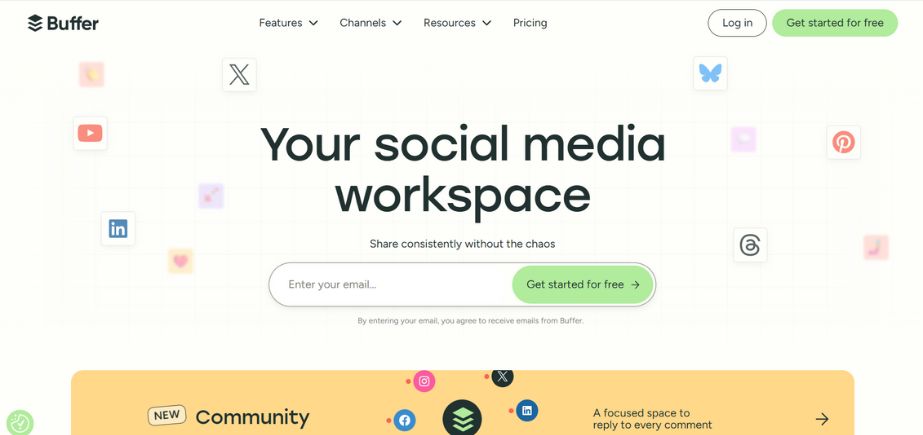
Buffer is an SMO interface that can be used by people with low technical expertise because it is extremely simple in terms of scheduling, content posting, and analyzing on major social media sites. It has a clean interface; this makes it suitable when you are working with small teams or you are a beginner. It is with the use of a buffer that you are able to schedule posts, monitor engagement, and improve content success through analytics that already exist.
The browser extension and mobile app enhance usability. It allows managing Facebook, Instagram, Twitter, LinkedIn, and Pinterest, which is why it is also a valid option as a platform that allows running a smooth everyday process of social media management with uniformity.
Notable Features:
- Clean, intuitive interface with drag-and-drop content calendar
- Advanced analytics with customizable reporting dashboards
- AI-powered optimal timing recommendations for each platform
- Browser extension for easy content curation and sharing
- Team collaboration tools with approval workflows
Pros:
- Extremely user-friendly interface
- Excellent mobile app functionality
Cons:
- Limited advanced features compared to enterprise tools
- Fewer automation options than competitors
Best suited for:
Small to medium businesses, solopreneurs, content creators who prioritize simplicity and clean design
Pricing:
Free plan available; paid plans start at $6/month per channel
2. Hootsuite
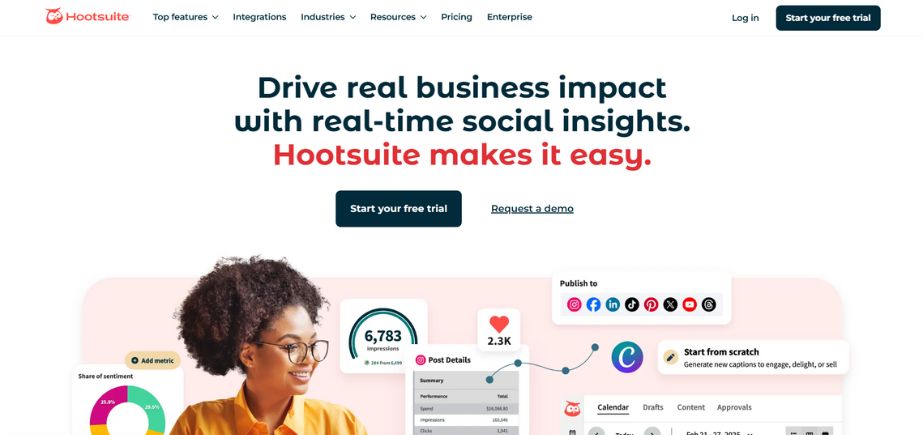
Hootsuite is a powerful social media marketing platform that provides all-in-one features of scheduling, monitoring, and analytics. It covers most of the different platforms, such as Facebook, Twitter, LinkedIn, Instagram, YouTube, and Pinterest. Teams will be able to cooperate when creating content plans, tracking brand mentions, and using its analytics. unified dashboard.
Hootsuite also has the ability to schedule in bulk, customizereports, and integratemore than 150 apps, which makes it best suited to work in agencies and large organizations that may have many social accounts to manage.
Notable Features:
- Support for 35+ social networks including TikTok and YouTube
- Advanced social listening and monitoring capabilities
- Social ads campaign management included in every plan
- Comprehensive team management with role-based permissions
- Integration with 100+ third-party apps and tools
Pros:
- Most comprehensive feature set available
- Excellent for large teams and collaboration
Cons:
Steeper learning curve for new users
Can be overwhelming for beginners
Best suited for:
Large enterprises, agencies, marketing teams needing comprehensive social media management
Pricing:
Plans start at $99/month for 3 users; enterprise solutions available
3. Sprout Social
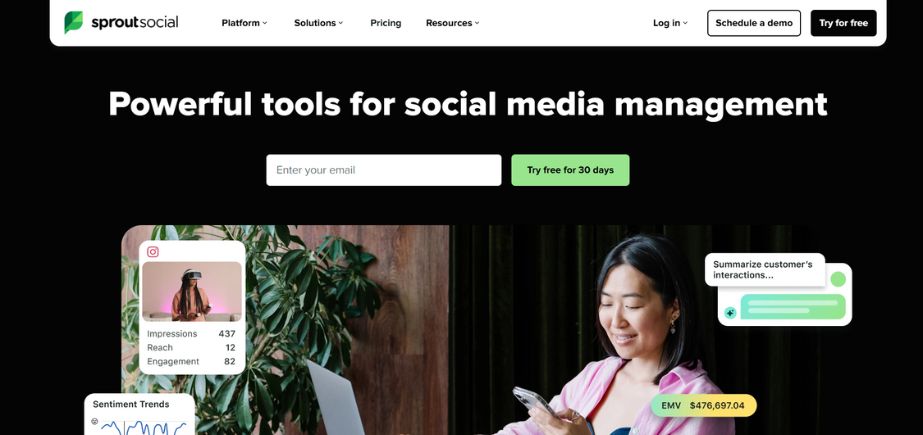
Sprout Social is one of the best SMO tools that is characterized by high-level analytics, CRM integration, and collaboration features. It is compatible with all large social networks and has intelligent scheduling and tracking of followers, as well as intelligent management of the inbox. It allows businesses to optimize their content strategies with links to detailed performance reports and automated suggestions using AI.
With its comprehensive analytics, tightly integrated operations, and ability to make customer engagement flow fluid, Sprout Social will best serve enterprises that have a marketing staff or accept marketing-focused firms whose goals revolve around detailed insights, efficient workflows, and a smooth customer interaction process enabled by a singular and centralized platform.
Notable Features:
- Unified inbox for managing all social messages and comments
- Advanced CRM features for tracking customer interactions
- Detailed competitor analysis and benchmarking tools
- Smart inbox with automatic message tagging and routing
- Comprehensive influencer identification and outreach tools
Pros:
- Excellent customer service features
- Superior analytics and reporting
Cons:
- Premium pricing structure
- May be overkill for small businesses
- Limited free trial period
Best suited for:
Medium to large businesses, B2B companies, brands focusing heavily on customer service through social media
Pricing:
Plans start at $249/month per user with 5 social profiles included
4. Later
Later is a visual social media posting tool that mainly targets Instagram, but it also offers services on Facebook, Twitter, LinkedIn, and TikTok. It includes a drag-and-drop calendar, hashtag suggestions, and link-in-bio management. Later, it makes it ideal to handle brands that have a good visual identity, as media planning and previewing would become effortless. Its analytics features give an idea about interaction and the best time to post. Later is the most suited platform for content creators and small businesses, as they have a focus on visual storytelling.
Notable Features:
- Visual content calendar with drag-and-drop functionality
- Auto-publishing for Instagram Stories and Reels
- Linkin.bio tool for driving traffic from social posts
- User-generated content management and rights clearing
- Advanced hashtag suggestions and performance tracking
Pros:
- Excellent for visual content planning
- Strong Instagram-specific features
Cons:
- Limited text-based social network features
- Fewer analytics than major competitors
Best suited for:
Visual brands, e-commerce businesses, Instagram-focused marketers, content creators
Pricing:
Later’s pricing starts at $25 USD per month after the free tier
5. SocialBee
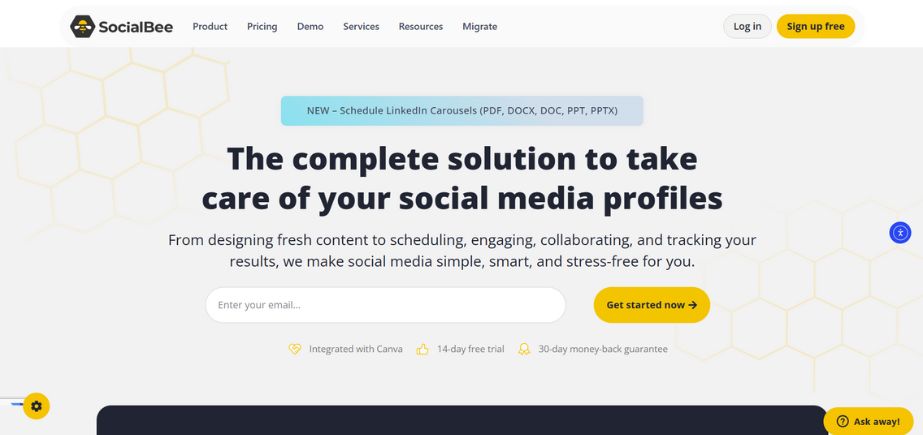
SocialBee is amongst the SMO tools that allows companies to plan and publish their content on different platforms, with an emphasis on categories. It provides automation, evergreen content recycling, and post variation that saves plenty of time yet still offers diversity. SocialBee is compatible with Facebook, Instagram, Twitter, LinkedIn, Pinterest, TikTok, and Google Business Profile. The fact that it has audience targeting, link tracking, and performance analytics makes it a dream when used by solopreneurs, marketers, and small teams that need an accessible and effective SMO tool.
Notable Features:
- Content categorization system for balanced post scheduling
- Evergreen content recycling with automatic reposting
- RSS feed integration for automatic content curation
- Built-in Canva integration for quick graphic creation
- Detailed audience growth tracking and analytics
Pros:
- Unique content categorization approach
- Excellent for evergreen content management
Cons:
- Smaller user base than major competitors
- Fewer integrations available
Best suited for:
Bloggers, coaches, consultants, businesses with evergreen content strategies
Pricing:
Starts at $25/month; 14-day free trial available
Don’t miss: Market Research Tools
6. Metricool
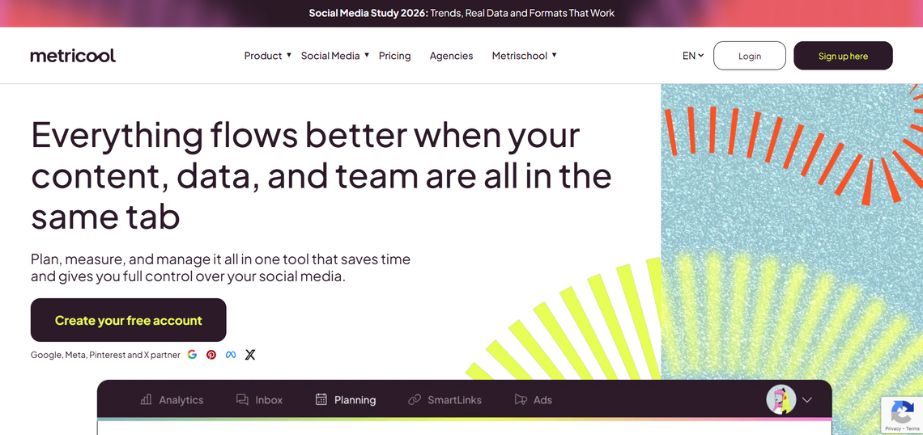
Metricool is a powerful and flexible SMO and analytics service that gives you the possibility to plan, schedule, and track content on social media, blogs, and ad campaigns. It is compatible with Facebook, Instagram, LinkedIn, TikTok, Twitter, Pinterest, and YouTube. It has a clear dashboard that gives real-time metrics, tracks competitors, and provides reports. Monitoring of Google and Facebook Ads is also possible with Metricool. It is perfect to be used by marketers and their agencies that require posting features as well as having concise data-driven information in a single service.
Notable Features:
- Cross-platform analytics dashboard with custom date ranges
- Competitor tracking and benchmarking tools
- Social media ROI calculation and reporting
- Hashtag performance analysis and optimization
- Link tracking with detailed click analytics
Pros:
- Strong analytics focus and data insights
- Competitive pricing structure
Cons:
- Interface could be more intuitive
- Limited content creation features
Best suited for:
Data-driven marketers, agencies needing detailed reporting, businesses focused on ROI measurement
Pricing:
Free plan available, paid plans start at $18/month
7. Sendible
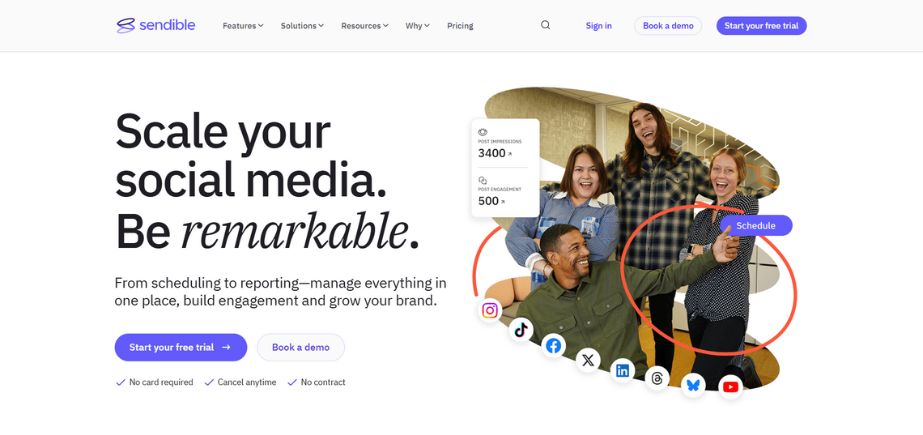
Sendible is one of the most effective SMO tools that are specifically designed to work with agencies and marketing teams that have a number of clients. Its features permit scheduling of posts, social listening, and in-depth analytics on all the top-level platforms. Sendible offers content approval workflows and Canva and Google Drive integration and has a smart inbox to easily communicate. It has bespoke dashboards and white label features that make it suitable in the context of agencies requiring efficiency, scalability, and branding towards the individual client in the social media management process is being carried out.
Notable Features:
- White-label dashboard for agencies and consultants
- Client approval workflows and permission management
- Smart queues with automatic optimal time scheduling
- Social CRM features for lead tracking and nurturing
- Comprehensive keyword and mention monitoring
Pros:
- Excellent for marketing agencies
- Strong client management features
Cons:
- Interface feels dated compared to newer tools
- Fewer integrations than major competitors
Best suited for:
Marketing agencies, consultants, businesses needing client management features
Pricing:
Plans start at $29/month for 1 user and 12 social profiles
8. ContentStudio
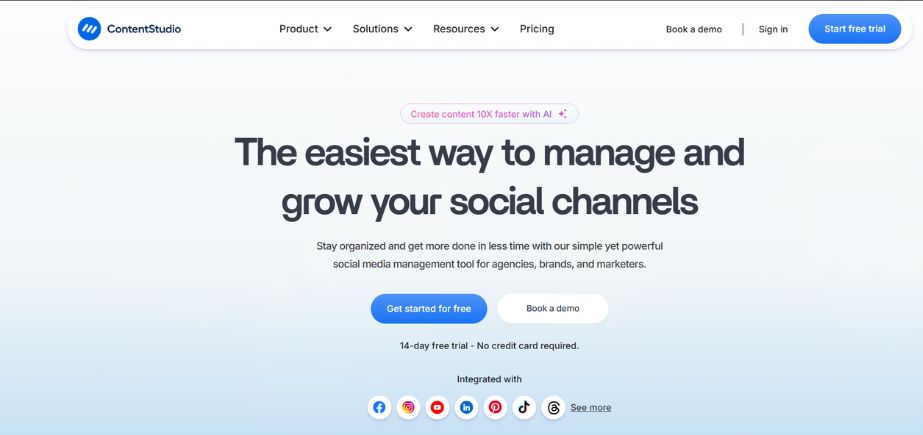
ContentStudio is a self-governing SMO apparatus that incorporates artificial intelligence, which helps to describe, arrange, disseminate, and screen content. It assists you in curating trending materials, designing custom posts, as well as automating through Facebook, Twitter, LinkedIn, Instagram, and Pinterest. It is also easy with content calendars, collaboration tools, and automation guidelines that enable collaboration with teams as well as individual creators. With its inherent SEO features and engagement metrics, it is a wise option to choose by brands only concerned with the former and the latter.
Notable Features:
- AI-powered content discovery and curation engine
- Advanced content planning with editorial calendar
- Social inbox for unified message management
- Detailed competitor analysis and content gap identification
- Custom branded reports for client presentation
Pros:
- Strong content discovery features
- Good value for money
Cons:
- Can be overwhelming for beginners
- Mobile app needs improvement
Best suited for:
Content marketers, agencies, businesses needing strong content curation capabilities
Pricing:
Bootstrap: $29/month, Accelerate: $49/month, Pro: $99/month
9. Zoho Social
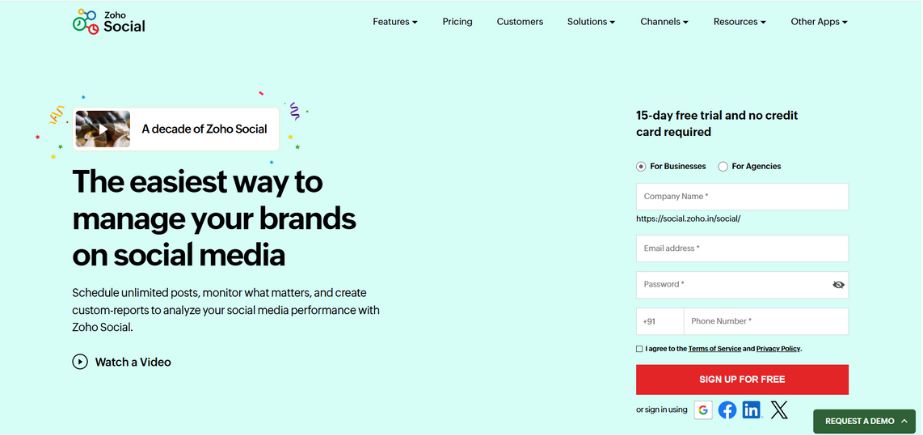
Zoho Social is an entire social media management platform with post schedulers, monitoring, analytics, and team collaboration functionalities. It allows using Facebook, Twitter, Instagram, LinkedIn, Google Business Profile, and YouTube. It is an excellent tool to coordinate the workout on social media, with sales having been integrated with Zoho CRM. Zoho Social is also a great option, as it offers real-time monitoring, hashtag tracking, and smart schedules, which makes it more suitable for small and mid-size business owners who would rather use a comprehensive tool.
Notable Features:
- Deep integration with Zoho CRM and other Zoho applications
- SmartQ technology for optimal posting time recommendations
- Real-time monitoring dashboard with keyword tracking
- Custom audience targeting and segmentation
- Built-in image editor with templates and filters
Pros:
- Excellent Zoho ecosystem integration
- Affordable pricing structure
Cons:
- Limited standout features
- Smaller third-party integration library
Best suited for:
Existing Zoho users, small to medium businesses, companies prioritizing CRM integration
Pricing:
Plans start at $10/month per brand with 1 user included
10. Publer
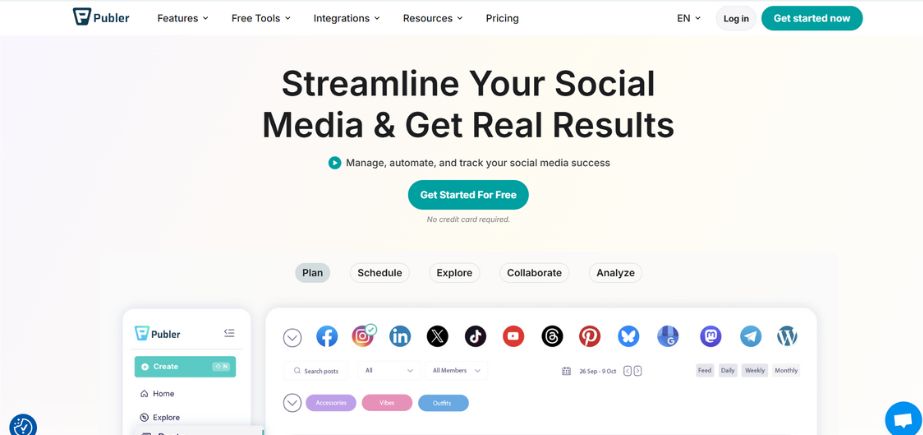
Publer is a relatively new SMO tool that allows posting, tracking, and automated publication on all Facebook, Instagram, Twitter, LinkedIn, Pinterest, TikTok, and YouTube. It enables uploading in bulk, auto-scheduling, and suggestions of hashtags, and even allows customizing posts according to particular platforms. Publer additionally provides built-in editing tools for the media, shortening links, and previewing. Publer provides affordable and feature-rich options, which makes it a good choice as a social media tool that will help freelancers, startups, and small teams get a hold of the content without there being a major learning process involved.
Notable Features:
- Bulk scheduling with CSV import functionality
- Auto-posting with watermark-free image processing
- Link shortening with detailed click tracking
- Team collaboration with approval workflows
- Multi-account management with workspace organization
Pros:
- Very affordable pricing structure
- Clean and intuitive interface
Cons:
- Newer platform with smaller user base
- Limited advanced analytics
Best suited for:
Budget-conscious businesses, small teams, users needing bulk scheduling capabilities
Pricing:
Paid plans start at $12/month with free plan available
Benefits of Using SMO Tools
Using proper SMO tools can change your social media strategy in a number of very important ways. These sites will still save you time due to automation and bulk scheduling to keep your posting schedules regular on all platforms, but they will also save you a great deal of time when you create weeks or even months’ worth of content in advance.
SMO technologies enhance the post visibility and engagement by analyzing when to post and proposing trending hashtags and content optimizations. This is because this type of data-based strategy will make your content wide-reaching, and it appears when most people are likely to engage with it.
The tools will enable consistent branding of all social platforms through the templates, brand asset libraries, and approval processes, which will mean that all posts will align with your brand guidelines and voice.
Above all, SMO tools provide performance indicators that could be acted upon in the form of deep analytics dashboards. You will be able to monitor the kinds of content that work the hardest, the kind of audiences that you interact with the most, and the amount of ROI on all your social media engagements.
Last, these tools permit effective team cooperation using user permissions, workflow authorizations, and content schedules to keep everybody in agreement regarding social media goals and messages.
Conclusion
SMO tools are now an essential marketing requisite to succeeding in the modern-day world, as they provide the automation, analytics, and optimization functions so necessary to penetrate through the clutter of social media and to reach your audience in a meaningful way. Each of these tools presented in this guide has its own set of strengths, whether it is Buffer, which is easy to navigate, or Publer, which is pocket-friendly, or Hootsuite, which has it all.
The secret to success is picking the tool that will work best with the given content strategy, the number of people in your team, and the objectives you have in business. Take into account such aspects as your main social sites, the necessity of teamwork, cost requirements, and the extent of analytics you wish to have.
Most of the platforms will provide free trials and demo times before commitment; utilize all of these opportunities before you decide. This practical knowledge will guide you in choosing an interface that has a more natural feel for your team and what functions will make a difference in your social media performance.
Keep in mind that the SMO tool that your team will use is the best in the first place. Begin with the platform that fits your existing demands most, and do not be afraid to change as you advance your social media strategy and add some complexity to it.
FAQs
What is the distinction between SMO and SMM?
SMO (Social Media Optimization) concentrates on the optimization of organic posts and profiles to increase the level of visibility and interaction, whereas SMM (Social Media Marketing) considers both types of optimization and uses paid advertisement strategies. The difference between SMO and SMM is that the former is concerned with organically making your content ludicrously interesting and findable, whereas the latter involves spending money on the promotion of posts and advertisements.
Are SMO tools useful for SEO?
Indeed, SMO tools complement SEO activities. Social indicators will include shares, likes, and comments, and these can manipulate search and many SMO tools to assist in optimizing content to be found. There is also social media, which is frequently featured in searches, and repetition of branding using the same profile across varied platforms makes your online presence even stronger.
Are there any good value-free SMO tools?
Some of the tools have impressive free packages, which are Buffer (3 social accounts), Hootsuite (2 social accounts), Later (1 user, 1 social set per platform), and Metricool (basic analytics). Although less than the paid options, these non-paying plans offer some welcoming value to people and small enterprise entrepreneurs taking their steps into starting their social media optimization endeavors.
What is the best tool to use to support my brand through SMO?
Take into account the major social media, the number of people on your team, the funds, and the characteristics needed. Small to medium businesses may be satisfied by Later or Buffer, whereas enterprises require prompt solutions such as Hootsuite or Sprout Social. Agencies are to give attention to the tools that have features to work with clients, such as Sendible or ContentStudio. Any free trial should always be tested, and only then should you switch to a paid plan.
What is the optimal tool for Instagram optimization?
Later and Buffer are great when it comes to Instagram optimization through visual content schedules, arrangements of stories, and optimization of hashtags. Later is especially bright with its Linkin bio and management of user-generated posts, whereas Buffer also provides great Instagram analytics and time of posting proposals to achieve maximum engagement.