Automation of compliance has turned out to be a principal in the functioning of present-day business enterprises, reshaping the way organizations observe their compliance requirements. Simply put, compliance automation refers to the implementation of compliance automation tools to make regulatory mandates more efficient, trackable as well as manageable without having to manually take part in every requirement. This drive-thru technology has become more necessary due to the fact that businesses are increasingly facing a very complicated regulatory environment today.
The regulatory environment keeps changing quickly in industries. Financial services organizations have to meet such strict regulations as SOX or PCI-DSS, and healthcare providers have to cope with HIPAA or HITRUST compliance. To focus on SaaS and technology organizations, SOC 2 and ISO 27001 authentication are required, and the companies processing customer data must be aligned with the GDPR and CCPA policies. This complication has not only complicated manual compliance management, but more so, it has rendered the process ineffective.
This article is aimed at bringing to light the 10 most efficient compliance automation tools that emerged in 2025 to give organizations an idea of what strategies to adopt with regard to regulatory management in the organization. The tools introduce the pinnacle of compliance technology that is packed with functions to strike a balance between the burden of regulatory compliance reduction and better accuracy and efficiency.
Why Compliance Automation Tools Matters
Compliance automation is much more than a way of achieving the regulatory obligation. There are many challenges that are encountered by modern businesses, which can be addressed well through automation.
Reduces human error
Manual compliance is error-prone. Automation brings uniformity in tasks, minimizes errors, and allows precision by the use of continuous checks and balances.
Prevents costly penalties
Lack of adherence may result in fines, legal penalties, and the trivialization of reputation. Such risks are averted through automated systems that keep documentation and also provide real-time alerts.
Boosts speed and efficiency
Since automation reduces the required time to complete any audit and reporting processes, less manual effort and load on internal teams is required.
Stays updated with regulations
Laws change frequently. The automated tools are also continuously updated so that the organizations remain compliant without monitoring any changes at the manual level.
Delivers long-term cost savings
Although automation is initially costly, it saves labor, prevents compliance failure, and increases the efficiency of the process, resulting in huge financial gains.
Key Criteria for Selecting Compliance Automation Tools
The selection of the right compliance automation tool presupposes consideration of a number of essential factors. Being aware of these criteria will guide organizations to make decisions to fit their needs as well as legal regulations.
Regulatory coverage
Select the tools that comply with such major frameworks as GDPR, HIPAA, SOC 2, ISO 27001, and PCI DSS. Look for flexibility to adapt to future regulations.
Automation capabilities
Automated audit, real-time monitoring, alerts, reporting, and evidence collection are among the primary capabilities that allow minimizing manual work but make auditing precise.
Integration
The tool must be compatible with the rest of the systems, such as cloud services, HR software, and security tools, to ease the process of compliance tracking.
Ease of use and deployment
An intuitive interface and simple setup enable quick adoption. Clear dashboards and onboarding resources improve user experience.
Scalability
Make sure that the instrument would easily support the growth, i.e., the addition of users, data, and regulations, without experiencing a loss of performance.
Industry-specific features
Seek domain-specific features such as HIPAA workflows in healthcare or SOX compliance in finance to fulfill industry requirements.
Pricing and support
Compare all of it (license, setup, support), and compare vendors with good customer support and training.
Also Read: Best Software Companies in Vizag
Top 10 Compliance Automation Tools
1. Vanta
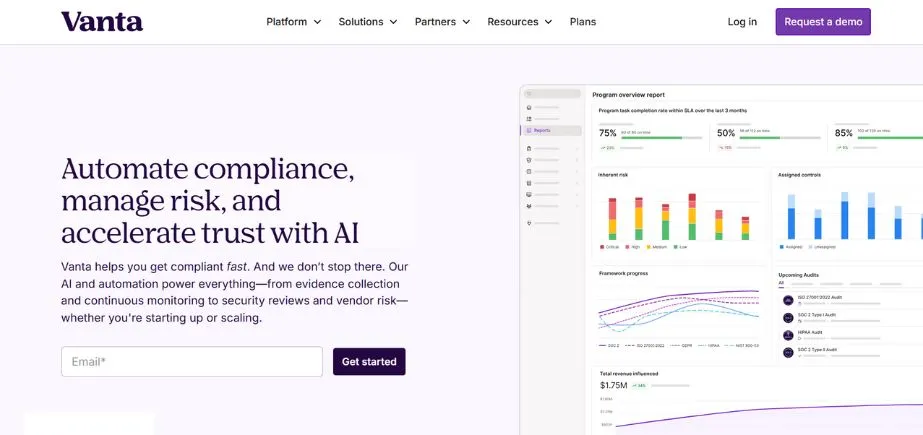
Vanta simplifies SOC 2, ISO 27001, HIPAA, and GDPR compliance by automating the gathering of evidence, the monitoring of security, and maintaining an audit-ready state. It also works alongside cloud services and productivity tools that guarantee constant compliance with little manual intervention. By enabling teams to be audit-ready throughout the year with real-time dashboards and alerts, Vanta makes sure to keep teams always on their toes. Developed with startups and high-growth businesses in mind, it saves on time spent during preparation and simplifies the work with auditors, so it is a choice for SaaS companies that require a quick and trustworthy compliance tool. This is one of the best compliance automation tools.
Key Features:
- Automated evidence collection from integrated systems
- Real-time compliance monitoring and alerting
- Streamlined audit preparation and management
- Comprehensive policy templates and frameworks
- Integration with 100+ business tools and cloud platforms
Pros:
- Excellent user interface with intuitive navigation
- Strong integration ecosystem covering major business tools
Cons:
- Premium pricing may be challenging for smaller organizations
- Some advanced features require additional configuration
Website:
vanta.com
Best suited for:
Mid-market and enterprise organizations requiring multi-framework compliance, particularly SaaS companies and technology firms.
2. Drata
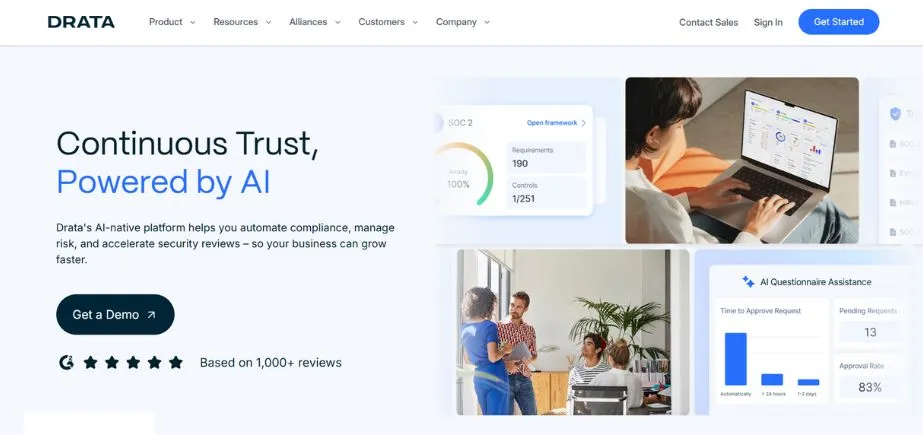
Drata is one of the compliance automation tools that provides automation of the entire SOC 2, ISO 27001, HIPAA, PCI DSS, and GDPR process. It integrates with your tech stack so that you can have live tracking, automated Auvid documentation, and ongoing control follow-up. Intuitive dashboard by Drata leaves companies ready to be audited yet minimizes human effort. It is also suitable to support growing technology organizations, making it easy to comply with intelligent workflows, rich reporting, and policy templates. Drata also enables you to work with auditors and share it to help you manage and better your security posture.
Key Features:
- Continuous control monitoring and testing
- Automated evidence collection and management
- Pre-built compliance frameworks and templates
- Risk assessment and remediation workflows
- Comprehensive audit trail and reporting
Pros:
- Strong audit preparation capabilities
- Excellent customer support and onboarding
Cons:
- Can be complex for organizations new to compliance automation
- Limited customization options for some frameworks
Website:
drata.com
Best suited for:
Organizations prioritizing audit readiness and continuous monitoring, particularly those in regulated industries.
3. Secureframe
Secureframe assists companies with securing and staying SOC 2, ISO 27001, PCI DSS, HIPAA, and GDPR compliant. It automates policy generation, risk analysis, collection of evidence, and ongoing observation. The system fits all key cloud platforms and tools and includes real-time compliance status and simplified audit preparation. Guided workflows on Secureframe are specific to quickly growing startups and mid-sized companies, resulting in a shorter time and effort on compliance procedures. Its experts in compliance also provide tailor-made assistance to make sure that organizations keep up with the changing agenda.
Key Features:
- Automated compliance testing and monitoring
- Real-time control status updates and alerts
- Comprehensive evidence collection and storage
- Built-in training modules for employees
- Asset and personnel management capabilities
Pros:
- User-friendly interface with minimal learning curve
- Strong automation capabilities reduce manual work
Cons:
- Limited reporting customization options
- Some integrations may require additional setup
Website:
secureframe.com
Best suited for:
Small to medium-sized businesses seeking straightforward compliance automation with strong educational support.
4. Hyperproof
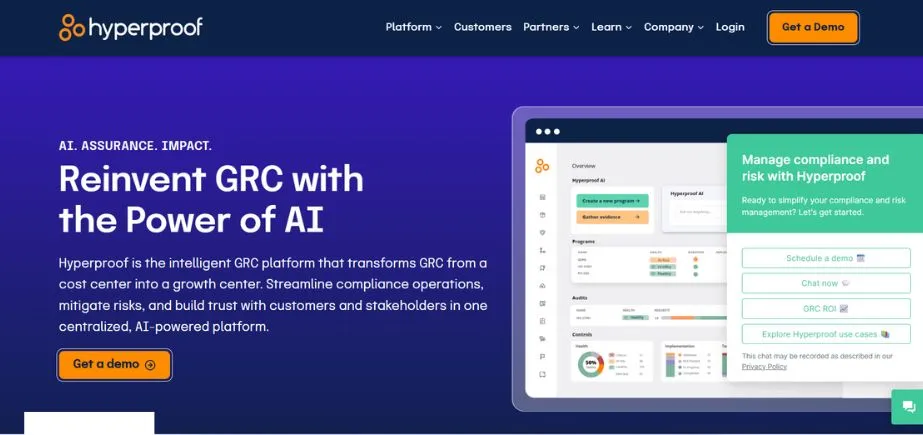
Hyperproof is a powerful compliance operations platform that consistently fits many frameworks, such as SOC 2, ISO 27001, GDPR, and NIST. It also focuses on the workflows of risk and compliance, providing the possibility to monitor and control continuously, retrieve evidence automatically, and manage tasks. Hyperproof is plugged into productivity and security solutions, which streamline the attainment of compliance for teams. It’s best suited to each organization with multifaceted or multi-standard compliance. It also offers real-time visibility, auditability, and a virtual compliance and security teamwork environment.
Key Features:
- Collaborative workflow management
- Centralized evidence repository
- Automated compliance testing and monitoring
- Risk assessment and management tools
- Multi-framework support and mapping
Pros:
- Excellent collaboration features for compliance teams
- Comprehensive evidence management system
Cons:
- Steeper learning curve for new users
- Higher cost considerations for smaller organizations
Website:
hyperproof.io
Best suited for:
Larger organizations with dedicated compliance teams requiring collaborative features and long-term compliance management.
5. LogicGate
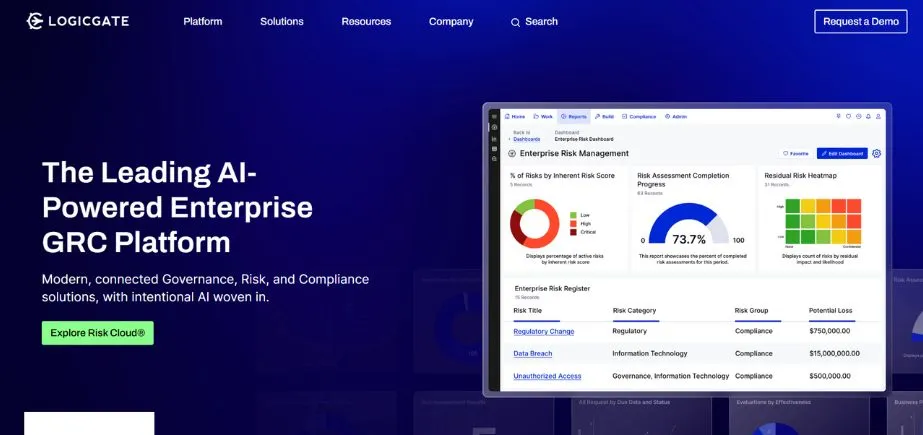
LogicGate is a no-code and flexible system to automate governance, risk, and compliance (GRC) workflows. The company has developed Risk Cloud, which assists organizations in managing enterprise risks, regulatory needs, and compliance activities in customizable programs. LogicGate helps with controls tracking, risk evaluation, and audit tracking in frameworks such as SOC 2, GDPR, and ISO standards. Its visual workflows, integrations, and reporting tools make the solution perfect for managing risk and compliance programs in organizations and easily handling the effort in scaling them without compromising transparency and accountability between departments.
Key Features:
- No-code workflow automation and customization
- Comprehensive risk assessment and management
- Automated compliance monitoring and reporting
- Integration with existing business systems
- Flexible data modeling and analytics
Pros:
- High degree of customization and flexibility
- Strong risk management capabilities
- No-code approach enables rapid deployment
- Comprehensive analytics and reporting features
Cons:
- May require significant setup time for complex use cases
- Learning curve for maximizing customization features
Website:
logicgate.com
Best suited for:
Organizations requiring highly customized compliance solutions with strong risk management capabilities.
6. ComplyAdvantage
ComplyAdvantage is a niche compliance solution provider that deals with anti-money laundering (AML), detection of fraud, and management of financial crime risks. It applies AI to manage transactions, filter customers, and detect high-risk situations in real-time. Its international sanctions and watch list information assist financial institutions in agreement with the regulations in FATF, FinCEN, and EU-AML directives. ComplyAdvantage is a highly utilized fintech tool in bank and crypto compliance that can handle onboarding compliance, KYC/AML checks, and customer or transaction monitoring.
Key Features:
- AI-powered risk assessment and screening
- Real-time sanctions and watchlist monitoring
- Automated AML and KYC compliance workflows
- Comprehensive case management system
- Advanced analytics and reporting capabilities
Pros:
- Specialized expertise in financial crime compliance
- Advanced AI capabilities for risk detection
- Comprehensive coverage of financial regulations
- Strong case management and investigation tools
Cons:
- Limited applicability outside financial services
- Can be complex for organizations without compliance expertise
Website:
complyadvantage.com
Best suited for:
Financial services organizations requiring specialized AML, KYC, and sanctions compliance capabilities.
Read More: Top Finance Companies in Bangalore
7. Sprinto
Sprinto provides cloud-native compliance automation of SOC 2, ISO 27001, GDPR, and HIPAA. It works with small and mid-size SaaS enterprises and streamlines the creation of policies, gathering of evidence, monitoring of risk, and coordination with auditors. Sprinto is able to encompass cloud platforms and developer tools to maintain real-time tracking of control, monitoring, and uninterrupted audit preparedness. It uses guided workflows to cut compliance time and human error and is therefore well suited to startups that must overcome a security or privacy compliance challenge quickly and at low overhead.
Key Features:
- Multi-framework compliance automation
- Continuous control monitoring and testing
- Automated evidence collection and management
- Risk assessment and remediation workflows
- Comprehensive audit preparation tools
Pros:
- Strong multi-framework support
- Effective continuous monitoring capabilities
- Comprehensive audit preparation features
- Good value for money compared to competitors
Cons:
- Newer platform with less market presence
- Limited advanced customization options
Website:
sprinto.com
Best suited for:
Growing organizations requiring comprehensive compliance automation across multiple frameworks at competitive pricing.
8. AuditBoard
AuditBoard is a risk and compliance program management platform at an enterprise level. It also maintains SOX, internal audits, IT risk management, and enterprise compliance on various frameworks. It has integrated modules, RiskOversight, OpsAudit, and CrossComply, that are tailored to streamline workflows, automate documents, and establish real-time collaboration. Large organizations rely on AuditBoard to enhance visibility, eliminate audit fatigue, and maintain regulatory compliance needs effectively. With its high level of scalability, robust reporting, and easy-to-use interface, it has become an easy and preferred choice when it comes to complex and enterprise-level compliance requirements.
Key Features:
- Integrated audit, risk, and compliance management
- Advanced workflow automation and collaboration
- Comprehensive reporting and analytics
- Enterprise-grade security and scalability
- Integration with existing enterprise systems
Pros:
- Comprehensive enterprise-level features
- Strong integration capabilities with enterprise systems
- Advanced collaboration and workflow management
- Excellent reporting and analytics capabilities
Cons:
- High cost may be prohibitive for smaller organizations
- Complex implementation process for full feature utilization
Website:
auditboard.com
Best suited for:
Large enterprises requiring comprehensive audit, risk, and compliance management with advanced collaboration features.
9. Tugboat Logic
Tugboat Logic automates the SOC 2, ISO, and GDPR compliance path with streamlined onboarding, mapping of controls, and audit preparation. The system provides evidence-gathering automation by offering policy templates, risk assessments, and compatibility with popular applications. Tugboat Logic was made to help startups and small- and midsize businesses get more straightforward and affordable stand-alone compliance. Its centralized dashboard and audit readiness reports make teams concentrated and focused. It also integrates directly with auditors to make the audit process and review simpler.
Key Features:
- Vendor risk assessment and management
- Third-party compliance monitoring
- Automated questionnaire and assessment workflows
- Comprehensive vendor documentation management
- Risk scoring and prioritization tools
Pros:
- Specialized focus on vendor risk management
- Comprehensive third-party compliance capabilities
- Strong automation for vendor assessment processes
- Effective risk scoring and prioritization
Cons:
- Limited functionality outside vendor risk management
- May require integration with other compliance tools
Website:
tugboatlogic.com
Best suited for:
Organizations with extensive vendor relationships requiring specialized third-party risk management capabilities.
10. OneTrust
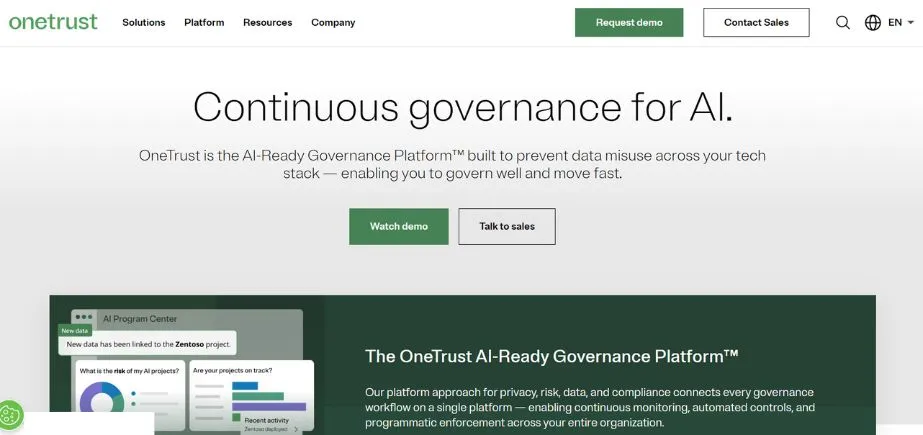
OneTrust is an end-to-end platform with privacy and security. It can handle numerous frameworks such as the GDPR, CCPA, ISO 27001, SOC 2, or NIST. Its modular architecture extends to data mapping, incident response, third-party risk, and policy management. Large businesses prefer OneTrust because it is rich in features, has good automated capabilities, and is scalable. It can assist organizations in harmonizing privacy and compliance programs, internationally standardizing them by global regulations, providing real-time monitoring, workflows, and analytics as a single annual system.
Key Features:
- Comprehensive privacy and data protection management
- Automated consent management and cookie compliance
- Data mapping and inventory capabilities
- Privacy impact assessment workflows
- Extensive integration with marketing and business tools
Pros:
- Leading privacy and data protection capabilities
- Comprehensive consent management features
- Strong integration with marketing and sales tools
- Extensive regulatory coverage for privacy laws
Cons:
- Can be complex for organizations new to privacy compliance
- Premium pricing for advanced features
Website:
onetrust.com
Best suited for:
Organizations requiring comprehensive privacy and data protection compliance, particularly those with significant consumer data handling requirements.
Comparison Table Between Compliance Automation Tools
| Tool | Key Regulations Supported | Key Features | Pricing Model | Best For |
| Vanta | SOC 2, ISO 27001, HIPAA, PCI, GDPR | Automated evidence collection, continuous monitoring | Annual subscription | Mid-market SaaS companies |
| Drata | SOC 2, ISO 27001, HIPAA, PCI | Continuous monitoring, audit preparation | Annual subscription | Audit-focused organizations |
| Secureframe | SOC 2, ISO 27001, GDPR, HIPAA | Automated testing, training modules | Monthly/Annual | Small to medium businesses |
| Hyperproof | Multi-framework support | Collaborative workflows, evidence management | Annual subscription | Large compliance teams |
| LogicGate | Customizable frameworks | No-code automation, risk management | Annual subscription | Highly customized needs |
| ComplyAdvantage | AML, KYC, Sanctions | AI-powered screening, case management | Annual subscription | Financial services |
| Sprinto | SOC 2, ISO 27001, GDPR, HIPAA, PCI, CCPA | Multi-framework automation | Annual subscription | Growing organizations |
| AuditBoard | Enterprise compliance | Integrated audit/risk/compliance | Annual subscription | Large enterprises |
| Tugboat Logic | Vendor risk management | Third-party assessments | Annual subscription | Vendor-heavy organizations |
| OneTrust | GDPR, CCPA, Privacy laws | Privacy management, consent tools | Annual subscription | Privacy-focused compliance |
Use Cases by Industry
The industries have specific compliance issues that might need specific procedures and tools. Appreciating these are industry needs can ensure that organizations make the best decisions regarding compliance automation solutions selection.
Healthcare: HIPAA and HITRUST
The healthcare providers should be able to protect patient data according to HIPAA and HITRUST requirements. Such tools as Vanta and Drata automate HIPAA compliance, access controls, access monitoring, and breach detection and create audit-ready reports, making the process of ensuring compliance and remaining secure with fewer manual processes needed by healthcare teams.
SaaS and Tech: SOC 2 and ISO 27001
To demonstrate data security, SaaS and technology companies require a SOC 2 and ISO 27001 certification. Automation of control checks, feature monitoring, and integration with cloud and dev tools are used by Secureframe and Sprinto to make the audit more condensed and keep security criteria on a high level.
Finance: PCI-DSS and SOX
Financial companies are required to fulfill PCI-DSS and SOX. ComplyAdvantage was in charge of financial crime compliance, and AuditBoard took care of SOX workflow and provided real-time monitoring, access control checks, and correct financial reporting tools.
E-commerce: GDPR and CCPA
Before GDPR, the protection of customer data required e-commerce companies to comply with the CCPA. OneTrust automates data privacy management, such as the collection of consent, data mapping, and monitoring compliance across jurisdictions, to assist companies in complying with international data privacy regulations on an efficient basis.
Challenges Solved by Compliance Automation
Automation of compliance resolves a lot of issues that organizations encounter in the process of dealing with regulatory requirements manually. Here, learning about these obstacles will help explain the value of automation solutions.
Manual tracking of documentation
The manual terms of nodes of evidence gathering and policies organization are slow, prone to errors, and non-scalable, and therefore, traditional compliance is based on them. Automation consolidates the documents and collects evidence automatically and has everything in order and visible.
Delayed audit readiness
Audit preparation is time-consuming, which can hamper normal processes and require months of manual work. Automation provides constant preparedness as it records controls, obtains evidence, and keeps the status of compliance updated in real time.
Policy versioning issues
Managing multiple policy versions across departments is difficult. Automation allows policy control to be centralized and also allows tracking versions and updating automatically to enable consistency.
Lack of real-time risk visibility
Manual processes offer limited visibility into compliance risks. Automation provides constant monitoring, real-time alerts, and dashboards to get instant visibility of risk status and problems.
Conclusion
Automation of compliance is not a choice anymore—it has become a necessity today when the environment of control is getting increasingly complicated. The tools presented in the given article are the best solutions where the level of human involvement is reduced, accuracy is required, and effectiveness at maintaining compliance is increased.
In addition to the compliance standards, automation delivers the following value: enhanced risk visibility, reduced operational costs, accelerated audit preparedness, and expanded compliance models. Automating mindless work will also help companies have their compliance teams performing strategic and value-added work.
With a busier regulatory landscape, compliance automation is adopted in the organization sooner, the more agile and resilient the organization will be. The specific strengths of each of the tools present businesses with more opportunities to match them to the particular size and industry, as well as specific compliance requests.
It is all about being proactive; the first thing is to find out pain points, discover what tools can do, and use free trials or demonstrations to align. There are long-term rewards of efficiency, risk management, and cost reduction through investing in automation.
Make tools that will future-proof compliance by staying current with regulations, fitting into your current tech stacks, and growing with your business. The solutions mentioned here provide the foundation for the creation of flexible and sustainable programs of compliance, which allow for maintaining a sustainable level of success.
FAQs About Compliance Automation Tools
1. What is a compliance automation tool?
A compliance automation tool is software that assists organizations in automatically managing their regulatory requirements, such as monitoring controls, formulating evidence, generating reports, and ensuring compliance documentation. These tools help to reduce manual workload and enable better and precise accuracy in compliance.
2. What are the ways to select appropriate compliance software for my business?
Select regulatory compliance software depending on your regulatory needs, technology infrastructure, the size of your team, and budget. Pay attention to such aspects as regulatory coverage, integration possibilities, convenience, scalability, and support by the vendor. Begin by identifying their needs by comparing them with the available facilities in a gap analysis, and then testing or demonstrating several possibilities.
3. Are these tools suitable for startups and small businesses?
Yes, numerous compliance automation tools are customized to complement start-ups and small companies. Software such as Secureframe and Sprinto is affordable and has a simplified interface and implementation procedures. Yet, organizations are advised to screen expenses and functions well to afford the tool the appropriate value.
4. Can compliance automation reduce audit costs?
Yes, compliance automation is one of the ways that can help save a substantial amount of money spent on an audit, since the process of continuous audit readiness implementation, automation of evidence gathering, and organized documentation. Such functions save time and effort in preparing an audit, which results in the creation of an audit fee abatement and the internal resource demand to prepare an audit.
5. How should SOC 2 and ISO 27001 compliance tools differ?
SOC 2 specializes in covering security, availability, processing integrity, confidentiality, and privacy controls of service organizations, whereas ISO 27001 offers information security management systems an extremely comprehensive structure. There are those that concentrate on a single framework and others that support the two. Select those that are appropriate according to your customer’s expectations and specific certification needs.
Continue Exploring: Best Software Companies in Coimbatore